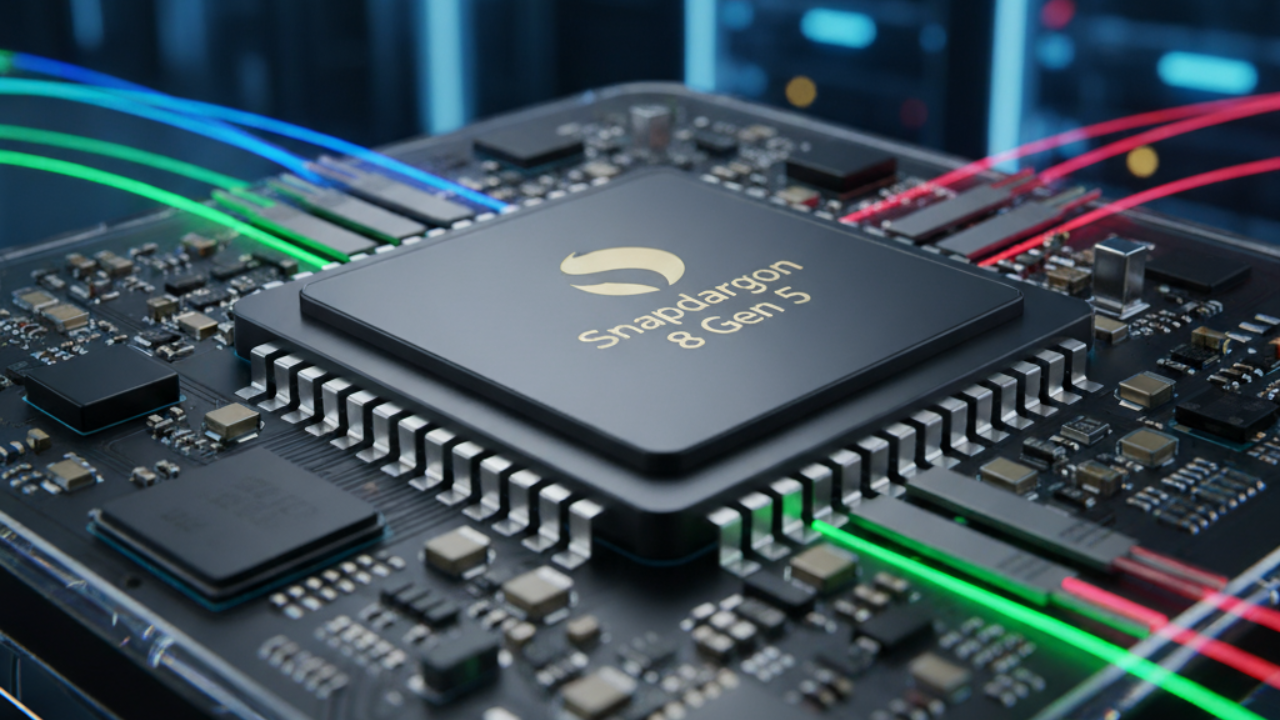
According to several reports, Samsung’s Galaxy S26 series, launching later this year, might deeply depend on Qualcomm’s Snapdragon 8 Elite Gen 5 chipset. Qualcomm executives have reportedly confirmed that their flagship processor will power around 75 percent of the Galaxy S26 models across the world, leaving only about 25 percent to run on Samsung’s in-house Exynos 2600 chip.
This move also indicates a continuation of Samsung’s dual-chip strategy, but with a stronger dependence on Qualcomm, which suggests that the company wants consistent performance and stability in its supply chain across major markets.
Qualcomm’s 75 Percent Share: What It Means
While in the previous Galaxy S25 series, Samsung settled on the Qualcomm chips across all models worldwide after skipping the Exynos 2500 owing to production and performance challenges, with the Galaxy S26, it looks like Samsung is getting ready to bring back Exynos, but very cautiously.
Qualcomm’s Snapdragon 8 Elite Gen 5 will reportedly dominate the lineup, accounting for about three-quarters of global production, while Samsung will limit its new Exynos 2600 chip to select regions such as Europe and parts of Asia.
Industry insiders say this ratio is no coincidence; it shows Samsung’s confidence in Qualcomm’s reliability and leadership in performance. The Snapdragon 8 Elite Gen 5 is expected to bring major upgrades in CPU and GPU performance, AI processing, and power efficiency—all key drivers for Samsung’s next-generation flagships.
Why Samsung Is Sticking with Qualcomm
A renewed partnership with Qualcomm has worked out great for Samsung over the last couple of years. The all-Snapdragon Galaxy S25 lineup was lauded for its stable thermals and efficient performance, along with consistency between regions.
With the Galaxy S26, Samsung returns to its old dual-chip strategy, but keeping Snapdragon at the helm minimizes risks. The Exynos 2600, fabricated on Samsung’s advanced 2-nanometer GAA process, is designed to narrow the performance gap with Qualcomm. Benchmarks are promising so far, with scores not too distant from Snapdragon levels, but Samsung seems cautious about scaling it globally until real-world testing proves consistent results.
For Qualcomm, the 75 percent underscores that Qualcomm is the leading Android flagship chip market. The latest chip features improved thermal management, faster neural processing units, and better graphics thanks to the Adreno 750 GPU. The Snapdragon 8 Elite Gen 5 also supports advanced AI capabilities designed to optimize photography, multitasking, and on-device intelligence—things at which Samsung’s high-end devices excel.
Regional Impact: Who Gets Which Chip
If you’re in the United States, China, or Japan, for instance, your Galaxy S26 will likely be powered by Qualcomm’s Snapdragon 8 Elite Gen 5. In Europe and India, you can also expect some limited models to come with the Exynos 2600. Samsung’s use of region-specific chips controls its supply costs and gives it flexibility in production, but it also leads to minor differences in performance and battery life between markets.
Consumers in Exynos regions can still expect strong results, but Qualcomm models are bound to retain an edge in sustained performance and efficiency. In reality, the key advantage of the Exynos 2600 lies in integration: Samsung’s modem, ISP, and AI cores are tuned to work with its hardware in ways that could deliver real energy efficiency advantages under the right conditions.
What This Means to Buyers
This expanded share by Qualcomm means that future Galaxy S26 buyers will see more uniform performance regardless of their location. The Snapdragon 8 Elite Generation 5 promises higher stability, faster AI processing, and improved 5G connectivity for flagship-smooth performance no matter the market.
If you happen to fall within the region that gets the Exynos 2600, the difference isn’t as notable, since Samsung’s 2 nm chip closes the gap to near parity in benchmarks and probably outdoes the older Exynos units where power management is concerned.
Still, Qualcomm’s dominance in three-quarters of Galaxy S26 devices speaks to how Samsung still relies on Snapdragon as the safer bet for flagship consistency and global reach.
Looking Ahead
The Galaxy S26 series is supposed to launch this February 2026, continuing the annual release cycle from Samsung. Looking at reports, it’s said that the Galaxy S26 Ultra and possibly the S26 Plus will mostly use Qualcomm chips, while the base S26 may see mixed variants depending on the region.
For Samsung, such a balanced approach will keep the innovative streak within its Exynos division intact, with Qualcomm’s tried-and-true stability providing assurances of mass-market reliability. For Qualcomm, this deal is a strategic win that cements its presence in premium Android devices for another year.
While the specific core makeups and clock speeds weren’t revealed, with Apple’s A19 Pro and MediaTek’s Dimensity 9400 turning up the heat, both Samsung and Qualcomm are doubling down on AI-driven processing and efficiency. With Snapdragon powering the majority of Galaxy S26 models, expect a nice blend of raw power, smarter performance, and better global consistency.

Final Thoughts
That Samsung chooses to let Qualcomm power 75 percent of Galaxy S26 units exhibits confidence and caution all at once. The company is banking on Snapdragon’s tested excellence while giving its Exynos another chance in specific markets. For the majority of buyers, this means smoother, faster devices backed by Qualcomm’s latest innovations. The Galaxy S26 series may bring in 2026 what could arguably be the most balanced generation to date, marrying the best of Qualcomm’s performance leadership with Samsung’s renewed Exynos ambition.