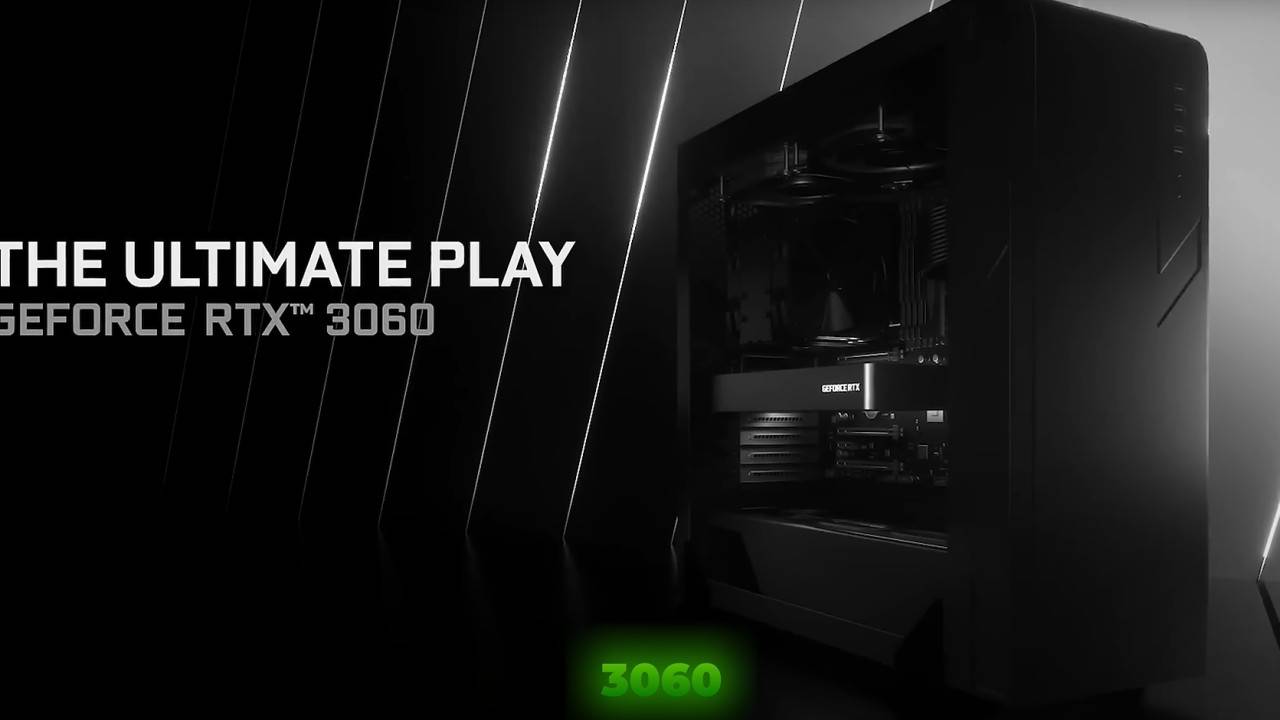
Later in 2025, NVIDIA introduced the GeForce RTX 5060, a GPU focused intently on the “sweet spot” of PC gaming: offering great performance at 1080p and competitive results at 1440p, while introducing the newest ray tracing, AI, and upscaling technologies. Built on the Blackwell architecture, the NVIDIA GeForce RTX 5060 is more than just a successor to the previous generation — it’s a compelling value proposition for both gamers and creators. In this post, we’ll explore the architecture, technical specs, performance, strengths and weaknesses, and what kind of user the 5060 is best suited for.
Architecture & Innovation: What Makes the RTX 5060 Stand Out
The core of the RTX 5060 is NVIDIA’s Blackwell architecture, which underpins the entire 50-series range. In comparison with previous generations, Blackwell offers significant enhancements in ray tracing, tensor (AI) cores, efficiency, and memory technologies. The RTX 5060 has PCI Express 5.0, which provides greater bandwidth for future motherboard support.
One of the most thrilling aspects of this GPU is DLSS 4, especially with Multi-Frame Generation (MFG). DLSS (Deep Learning Super Sampling) has already been a major differentiator within the NVIDIA platform, and version 4 goes even further with AI used to synthesize frames — improving performance without requiring strictly hardware brute force. Ray tracing also gains from 4th-generation RT cores, and 5th-generation Tensor cores support AI upscaling and other neural-rendering operations. Throw in features such as Reflex 2 (for reducing latency) and improved neural rendering, and it’s apparent the 5060 is more about intelligent performance — not mere brute power.
Specification Snapshot: What You Get Under the Hood
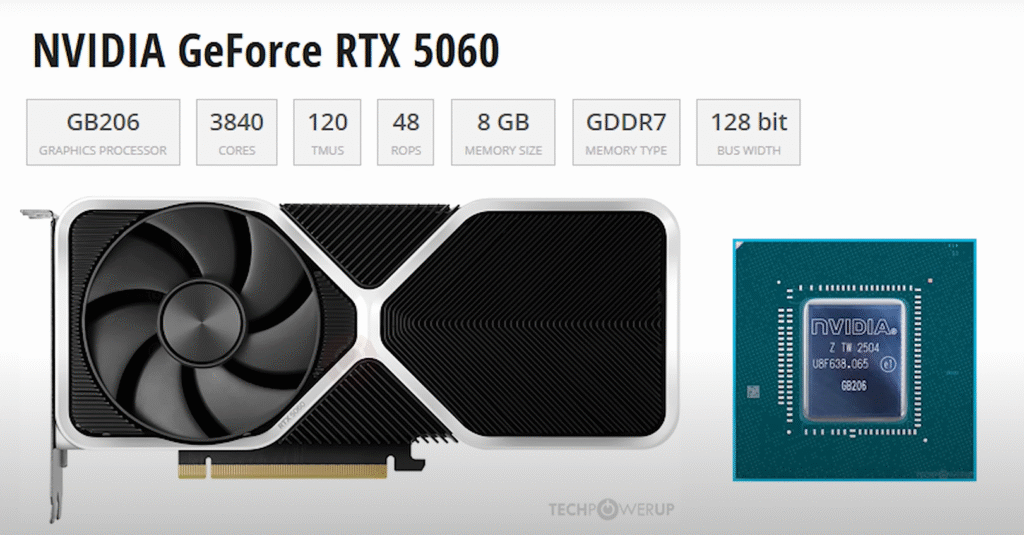
Below is a closer examination of the specs:
- CUDA Cores: ~3,840 — good compute horsepower for gaming and content creation workloads.
- Clocks: Boost clock approximately 2.50 GHz; base clock ~2.28 GHz (actual figures will vary depending on manufacturer).
- Memory: 8 GB GDDR7, clocked at about 28 Gbps, across a 128-bit bus. This gives around 448 GB/s of pure memory bandwidth. A quick interface for the class.
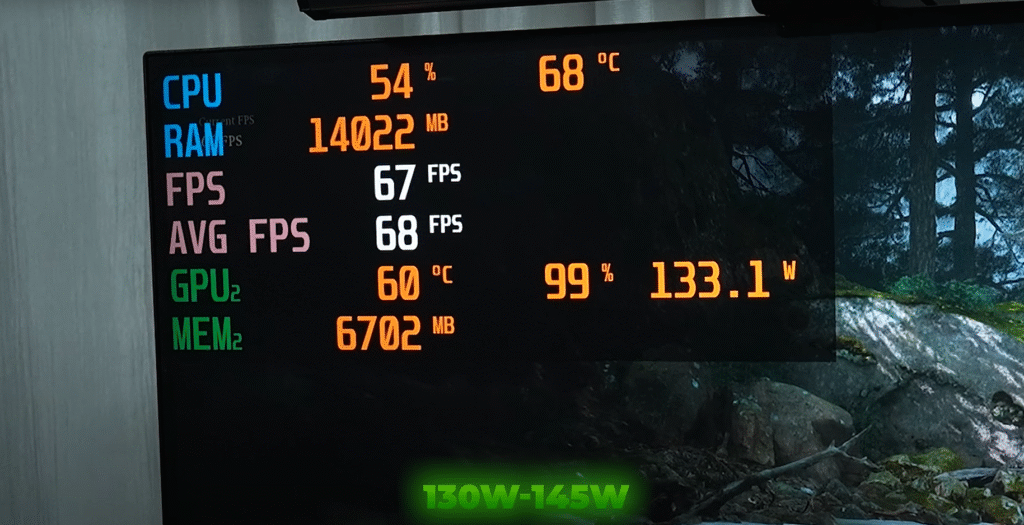
- Power: Typical Total Graphics Power (TGP) of ~145 W. The majority of partner boards tap power through a single 8-pin PCIe connector.
- Display Outputs: Variants (such as ASUS) feature HDMI 2.1b and DisplayPort 2.1b, with up to 4 monitors supported.
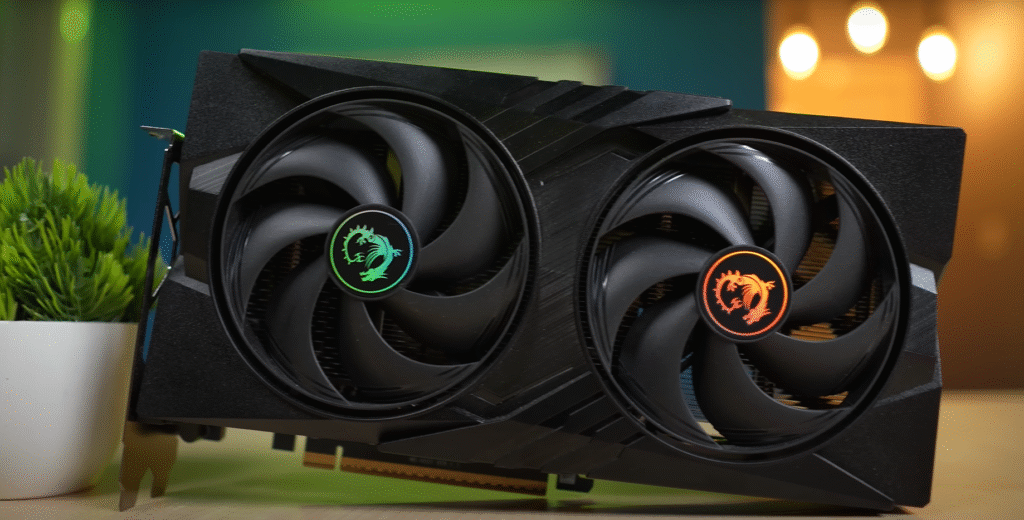
- Physical Size / Cooling: Example card dimensions around 228×123×50 mm (2.5-slot); you’ll need to verify fitment for your case.
- Architecture Features: Full PCIe 5.0 support, 4th-gen RT cores, 5th-gen Tensor cores, and all the latest NVIDIA software stack optimizations.
Performance: What to Expect in Real-World Use
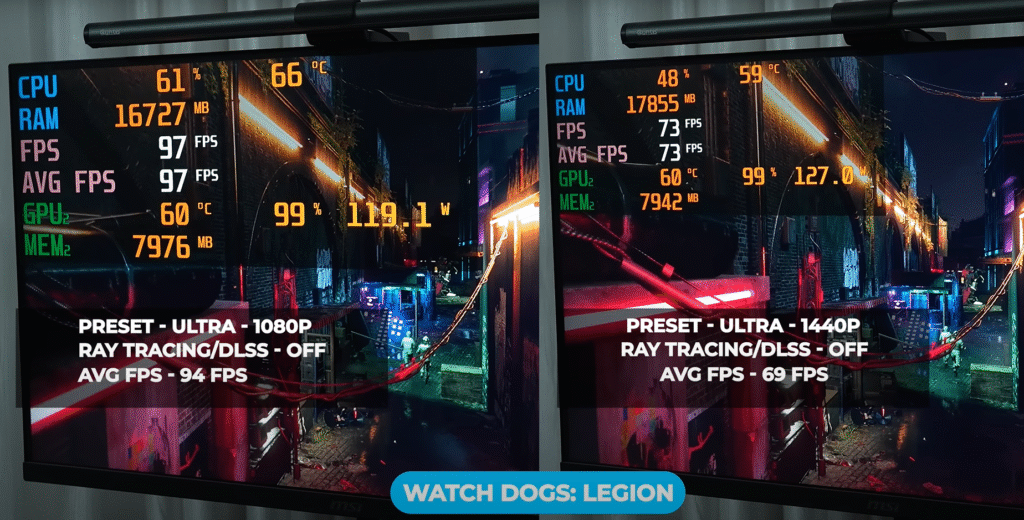
The RTX 5060 performance is obviously intended for gamers who crave high frame rates at 1080p with ray tracing turned on, and might want to dabble in 1440p at the expense of a few upscaling sleights of hand. NVIDIA markets it as a significant upgrade over previous generation “60-class” cards, due to architecture efficiency improvements, DLSS 4, and improved hardware support for real-time graphics workloads.
In reality, this translates to:
- At 1080p, expect silky, high-FPS performance even in gritty modern games, with ray tracing on and DLSS enabled.
- At 1440p, it begins to rely more on DLSS and upscaling — but is still very competent, particularly in less graphically intensive titles or with quality calibration.
- In ray traced tasks and content creation applications that can take advantage of AI features, the Blackwell architecture and tensor cores provide enhanced performance over previous generations.
But it’s not without compromises:
- Because DLSS MFG (frame generation) is a strong technology, much of the performance benefit relies on the quality of implementation within the game. In unoptimized titles, you won’t gain as much.
- Input latency and visual artifacts are issues with relying so heavily on AI-generated frames, particularly in quick-paced competitive titles. If your native framerate baseline isn’t strong, you might experience diminished responsiveness.
- The 8 GB of VRAM is usually plenty for 1080p and most 1440p pipelines (Makes it the Best 1080p & 1440p GPU 2025), but with ultra-high-res textures or next-gen titles, you might begin to reach limits before high-end models with more VRAM.
Strengths & Weaknesses: Where the RTX 5060 Excels — and Where it Falters
Let’s dissect the main benefits and compromises.
Strengths
- Modern feature set: ray tracing, DLSS 4, neural rendering, PCIe 5.0 — all for a relatively reasonable price.
- Efficiency: Lower power consumption than many top-tier GPUs, resulting in smaller power supply demands and reduced heat generation.
- Smart upscaling: DLSS MFG delivers a significant performance boost in supported games, with no massive hardware requirements.
- Value-driven design: With NVIDIA 5060 price of approximately $299 (launch), it aims for mass-market gamers who desire bleeding-edge features without requiring flagship hardware.
- Future-proof interfaces: High-bandwidth outputs (DisplayPort 2.1, HDMI 2.1b) and PCIe 5.0 assist in future-proofing.
NVIDIA’s roadmap doesn’t end with the RTX 5060 — their strategic deal with OpenAI in 2025 also plays a huge role.
Weaknesses / Considerations
- VRAM ceiling: 8 GB might constrain future headroom for ultra textures, large open worlds, or high-resolution.
- Leaning on DLSS support: Without solid game support, the performance benefit becomes smaller.
- Potential latency problems: Frames generated can cause input lag or visual glitches in latency-critical applications.
- Low performance at 4K: It’s not a 4K beast; high-res gaming will mean compromises.
- Cooling & noise: Depending on the partner board, overclocked models can add heat, noise, and power.
Who Should Consider the NVIDIA GeForce RTX 5060
It’s a great GPU for:
- 1080p players looking for high frame rates—yes, even with ray tracing—and the most “bang for buck” without shelling out premium money.
- Gamers seeking to move up to 1440p if they don’t mind reducing some of the settings and taking advantage of DLSS.
- Eferentes y creadores de contenido que utilizan características mejoradas con AI, rendimiento neural, y ray tracing pero no necesitan niveles de trabajo de VRAM ni.compute.
- System builders seeking future proofing (PCIe 5.0, new display outputs) but not extreme power consumption or cooling.
Not as ideally suited for:
- Individuals requiring extremely high native resolution (4K) performance without dependency upon upscaling.
- Titles or workflows that require enormous VRAM or very high fidelity textures.
- Competitive gamers who will not tolerate any possible latency compromise from frame-generation capabilities.
To understand NVIDIA’s broader strategy beyond GPUs, check out our detailed piece on the NVIDIA and OpenAI 2025 deal
Conclusion: Is the RTX 5060 Worth It?
The NVIDIA GeForce RTX 5060 strikes a solid equilibrium of contemporary GPU capabilities, performance, and value. It introduces future-proof architecture (Blackwell), cutting-edge ray tracing and AI innovations, and real-world memory and power requirements. To most gamers, particularly at 1080p and modest 1440p, it provides phenomenal value.
That being the case, dependence on DLSS support, the 8 GB VRAM limit, and possible input latency sacrifices are genuine concerns. But to those who are aware of the terrain and adjust expectations as such, the RTX 5060 is an extremely capable “mainstream high-performance” choice for 2025 and beyond.
If you prefer, I can also set up benchmarks (FPS in flagship games), directly compare it with AMD’s products, and verify price and availability in India (retail & gray market as of October 2025). Would you like me to extend this blog with that comparison section?
Alongside the launch of the RTX 5060, NVIDIA’s 2025 partnership with OpenAI is reshaping the future of AI and gaming.