SpaceX’s Starlink continues to reshape satellite broadband by mixing aggressive constellation expansion with steady technology upgrades, cementing its position as the most mature LEO internet network operating today. With millions of subscribers worldwide and traffic volumes more than doubling in 2025, the momentum of Starlink is being driven primarily by improvements at the satellite, network, and terminal levels.
| Category | Details |
|---|---|
| Network Type | Low Earth Orbit (LEO) satellite internet constellation |
| Operator | SpaceX |
| Global Scale | Millions of subscribers worldwide |
| Traffic Growth | Internet traffic more than doubled in 2025 |
| Satellite Deployment | 20–30 satellites launched per Falcon 9 mission |
| Orbital Altitude | Low Earth Orbit, significantly lower than geostationary satellites |
| Latency Performance | Comparable to terrestrial broadband in most regions |
| Supported Use Cases | General broadband, video conferencing, cloud gaming, enterprise workloads |
| Network Architecture | Software-defined satellite network |
| Software Updates | Frequent firmware updates to satellites and user terminals |
| Key Software Improvements | Beam steering optimization, congestion handling, satellite handoff efficiency |
| Obstruction Handling | Dynamic traffic rerouting in partially obstructed areas such as tree-covered locations |
| Hardware Ecosystem | Large-scale production of user terminals and ground infrastructure |
| Semiconductor Supply | Billions of radio-frequency chips shipped by partners |
| Terminal Design Trends | More power-efficient, compact, and easier to install |
| Mobility Applications | Aviation, maritime connectivity, emergency response services |
| Aviation Adoption | In-flight Wi-Fi deployments offering higher speeds and lower latency |
| Maritime Connectivity | Consistent global ocean coverage |
| Key Technical Challenges | Orbital congestion, spectrum coordination, signal interference |
| Mitigation Measures | Advanced collision avoidance systems and reduced-emission satellite designs |
| Competitive Advantage | High launch cadence combined with rapid software-driven optimization |
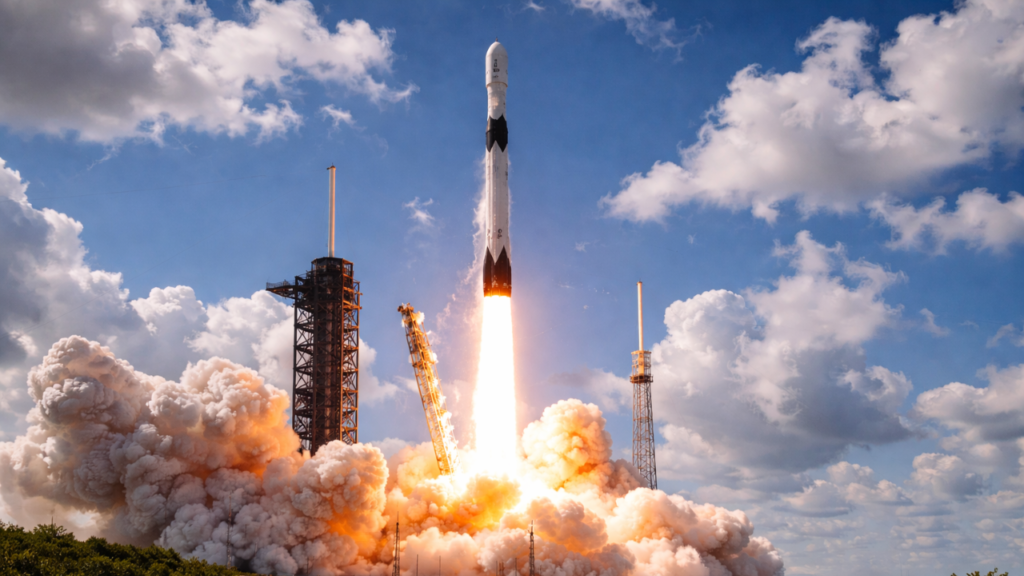
The core of Starlink’s technology is an ever-growing LEO satellite constellation. SpaceX continues to have one of the highest launch cadences in the aerospace industry, deploying up to 20–30 satellites per Falcon 9 mission. These satellites operate at a relatively low altitude, significantly reducing latency when compared to traditional geostationary satellites. Typical real-world latency now is said to rival terrestrial broadband in most regions, and Starlink is fit for more than just basic connectivity; it can also work for video conferencing, cloud gaming, and enterprise workloads.
Another significant technological differentiator is the constant optimization of the Starlink software-defined network. SpaceX very often pushes firmware updates to satellites and user terminals, enhancing beam steering, congestion handling, and handoff between satellites. Recent updates have enhanced performance even in partially obstructed environments, areas with tree cover, for instance, by dynamically rerouting traffic across available satellites in real time. This software-first approach allows Starlink to improve network quality without requiring hardware replacements for end users.
Also Read: ‘Disney OpenAI Deal 2025 Billion Dollar Investment and AI Future‘
On the hardware side, it’s a scaling ecosystem; billions of radio-frequency chips have been shipped by semiconductor partners for Starlink terminals, a reflection of the huge production volume of user equipment and ground infrastructure. Newer terminals are becoming increasingly power-efficient, compact, and easy to install, extending the appeal of Starlink beyond remote users to mobile platforms such as aviation, maritime, and emergency response services.
Technology from Starlink is also seeing increased adoption in mobility use cases. Airlines have started to deploy in-flight Wi-Fi using Starlink, taking advantage of the constellation’s high throughput and low latency to give passengers an in-flight internet experience much faster than that from previous satellite systems. Similar gains are being realized in maritime connectivity, as vessels enjoy consistent coverage across the globe’s oceans.
Despite that progress, Starlink has not been able to evade many of the technical challenges inherently connected with operating at scale. The congestion of orbits, coordination of spectrums, and interference, specifically from the scientific community, are increasingly evident as thousands of satellites occupy low Earth orbit. SpaceX responded to these demands with better collision avoidance systems and a series of satellite designs that reduce unintended emissions.
Overall, Starlink’s trajectory shines a light on how iterative engineering, high launch frequency, and software-driven optimization can transform satellite internet from a niche solution into a mainstream connectivity platform. As competition intensifies with other constellations, the technological lead remains one of the most important advantages of Starlink.
Also Read: ‘Disney OpenAI Deal 2025 Billion Dollar Investment and AI Future‘